With the latest changes in online search, search engines are increasingly displaying AI-generated summaries directly in the results, letting users get quick answers without clicking external links.
Google’s AI Overviews, Bing’s Copilot, and even ChatGPT’s search results are all pulling content directly into the conversation. And for most businesses, that feels like bad news.
However, we’ve been tracking our own performance in these AI-driven search results. And the numbers tell a different story than the doom-and-gloom headlines might suggest.
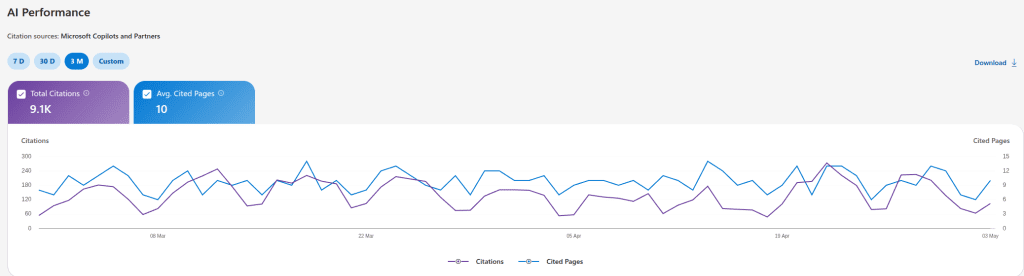
- Over the past 90 days, our content has been cited over 9,000 times by Microsoft Copilot and its partners (including ChatGPT), with 52 different pages on our site getting referenced.
- On Google’s side, we’re showing up in AI Overviews and AI Mode for competitive, high-volume queries — right alongside (and sometimes above) the biggest names in digital marketing.
Here’s how it happened, what the data looks like, and why it matters for your business, too.
What Does “AI Search Visibility” Even Mean?
Before we dive into numbers, a quick explanation is in order. Traditional SEO is all about ranking in the 10 blue links. You know the drill: optimize your page, earn some backlinks, and cross your fingers. But search in 2026 looks different.
Google’s AI Overviews pull information from trusted sources and summarize it right at the top of the results page. Bing’s Copilot and ChatGPT both use Bing’s search index to generate answers, and when they do, they cite specific pages as sources.
That means there’s a new layer of visibility happening in search. Your content shouldn’t just rank; it should be optimized so that AI systems will trust it enough to reference, cite, and summarize.
So how does a digital marketing agency in Birmingham, Alabama, become that source?
The Bing Side: 9,100 Citations Across 52 Pages
Let’s start with the data we can actually measure. Bing Webmaster Tools now includes an AI Performance report that shows how often your pages get cited by “Microsoft Copilots and Partners.” Because ChatGPT uses Bing’s search index, these citations could come from Copilot, ChatGPT, or other Bing-powered AI tools. There’s no way to distinguish right now, which you should keep in mind while you look at the numbers.
Over the past three months, Uptick’s data looks like this:
- Total AI citations: 9,100
- Average cited pages per day: 10
- Total unique pages cited: 52
Those 52 pages span our Learning Center, blog, and even some service pages. And the citation distribution tells you something interesting about what AI systems value.
Which Pages Are Getting Cited?
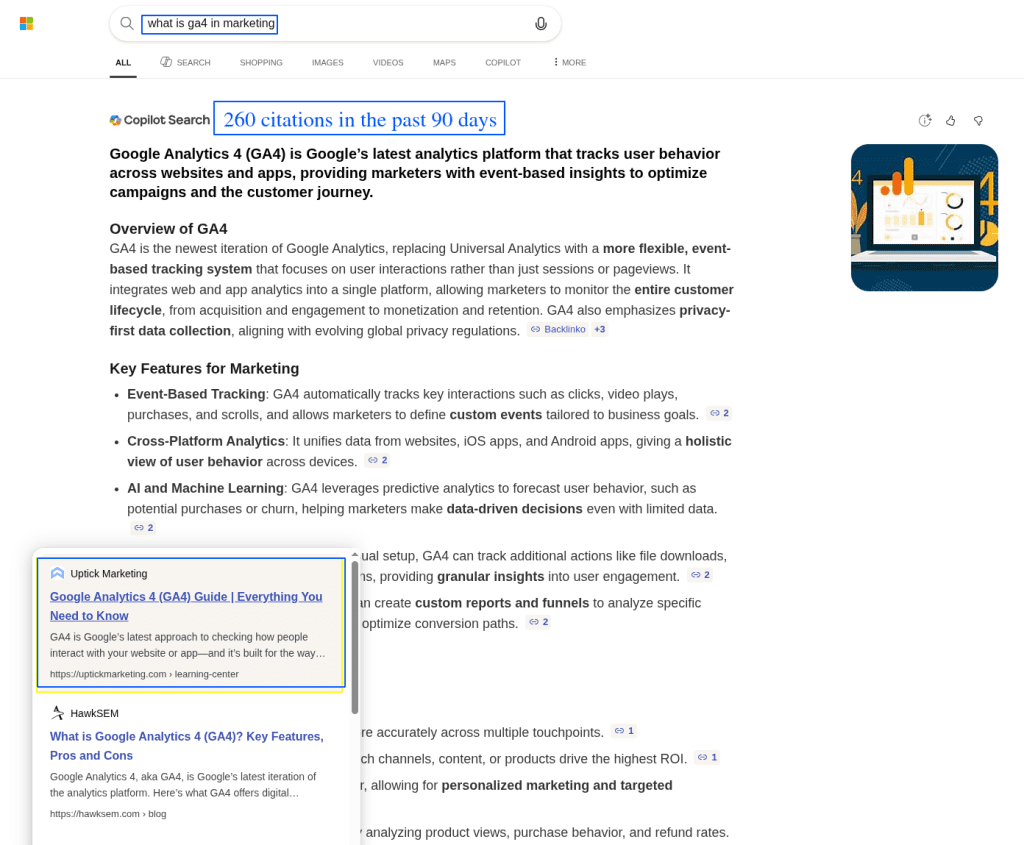
Our GA4 guide leads the pack with 4,402 citations. That’s a single page getting cited thousands of times by AI search tools, answering questions like “what is GA4,” “what is GA4 in marketing,” “GA4 meaning,” and dozens of variations. When someone asks Copilot or ChatGPT what GA4 is and how it applies to marketing, Uptick is the source they pull from.
Here are a few more topical examples:
- On-page SEO and technical SEO: Our “meta titles and descriptions” guide pulled 1,409 citations on its own. Guides on XML sitemaps, canonicalization, URL structure, and mobile-friendly design are also being cited.
- Google Ads and PPC: The advertiser verification explainer (548 citations), our “how to find your Google Ads account ID” guide (513), and articles on ad position, quality score, bidding strategies, and our best PPC platforms roundup are all part of the mix.
- Social media and content marketing: Guides covering X (Twitter) ad targeting, Meta Ads, Instagram Reels, and YouTube hashtags are getting picked up by AI tools when users ask platform-specific questions.
- Business strategy: Our article on strategies for small businesses to compete with big brands earned 218 citations, proving that AI search doesn’t just cite technical how-to content; it also cites strategic thinking. Articles on niche market targeting and industry-specific content strategies for manufacturers and financial institutions are on the list, too.
- Local SEO and Google Business Profile: Guides on GBP video verification (74 citations), managing GBP photos (36), and GBP posts are getting cited, along with our local SEO service page and articles on promoting your business locally.
- AI and AEO: Even our own content on AI search (including our article on schema’s role in AEO and GEO) is, ironically, being cited by the very AI systems we’re writing about.
The pattern should be obvious if you’ve read our articles: Educational, in-depth content that directly answers a specific question is exactly what AI search systems want to cite. These aren’t thin blog posts or 300-word summaries. They’re thorough, well-structured guides that cover a topic from start to finish.
It’s not a cheap strategy since it takes us a while to make sure we’re producing the best content we can. However, it’s worth it in the long run because it shows you that we put our money where our mouth is (we wouldn’t recommend something to clients that we wouldn’t do ourselves). What’s more, we’ve even seen this kind of success with clients’ content as well.
The Google Side: AI Overviews and AI Mode
Google doesn’t hand you a neat “AI citations” report the way Bing does. So tracking your presence in AI Overviews and AI Mode takes a bit more detective work. What we look for is a jump in impressions for a query without a matching jump in clicks. That pattern usually indicates your page is surfacing in an AI Overview (which generates an impression), but the user is getting their answer without clicking through.
Is that frustrating from a traffic standpoint? Sure, sometimes. But from a brand visibility and authority standpoint, it’s enormous. Your name, your content, and your expertise are being presented as a trusted source to thousands of people.
Besides, we’ve seen a 52 percent increase in clicks year over year, so it’s not like we’re at a loss. In fact, some of our biggest traffic sources are cited by AI Overviews (AIO), but not necessarily in the top 10. However, we’ve noticed that people are more likely to click if the AIO answer isn’t thorough enough, especially for practical “how-to” type queries. This may be something worth considering.
Now, here’s what we found when we dug into Uptick’s GSC data and manually verified our presence in AI Overviews and AI Mode:
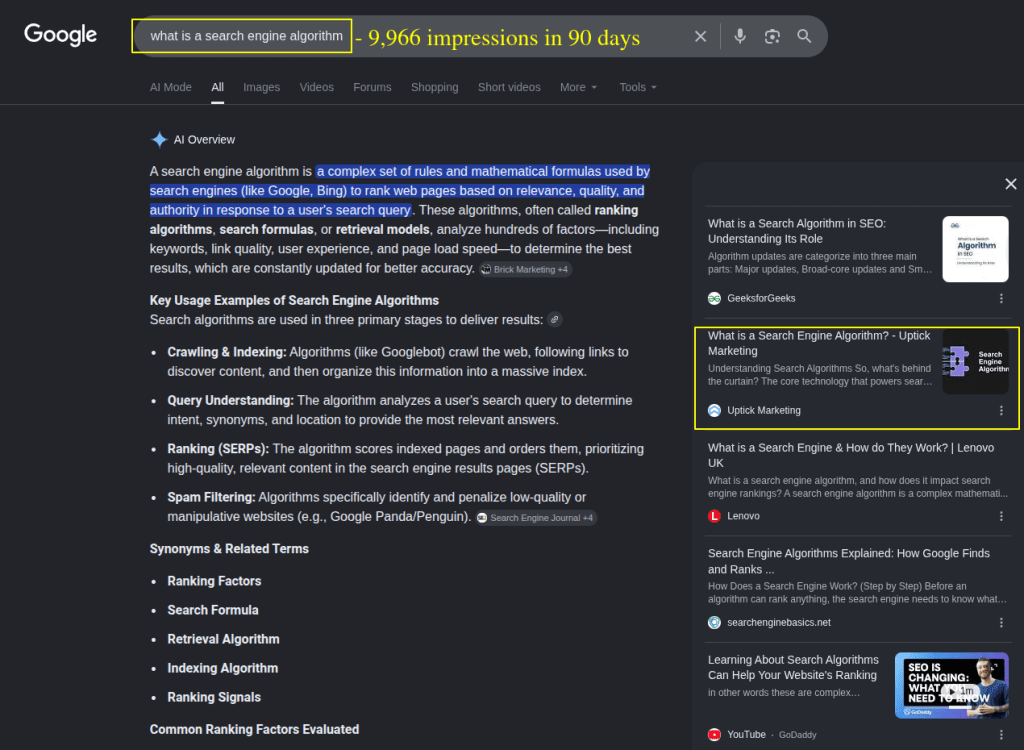
“What is a search engine algorithm” — 9,966 impressions in 90 days
This is a broad, top-of-funnel query (question) that people search constantly. Google’s AI Overview pulls from several sources to answer it, and Uptick’s article on search engine algorithms shows up in the organic results alongside it. With nearly 10,000 impressions in a quarter, that’s a lot of eyeballs on our brand for a query where we’re competing with the likes of Search Engine Journal, GeeksforGeeks, and Lenovo.
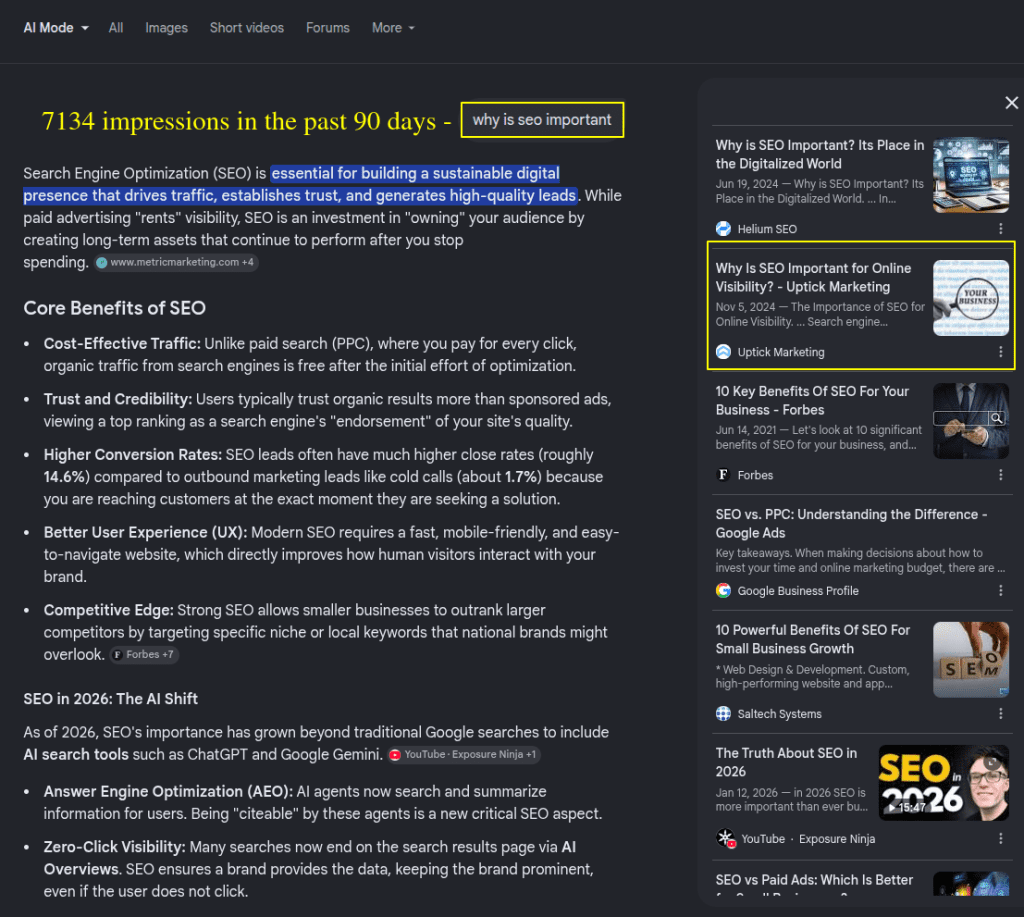
“Why is SEO important” — 7,134 impressions in 90 days
This one is a bread-and-butter query for any digital marketing agency. Google’s AI Mode generates a full breakdown of SEO’s benefits, and Uptick’s article on the importance of SEO appears right there in the results panel. We’re sitting next to Helium SEO, Forbes, and Google’s own Business Profile documentation.
More Examples Across Competitive Queries
The pattern repeats across a range of high-value topics:
- “Off-page SEO” — 5,391 impressions in 90 days, Uptick article visible alongside Moz, Semrush, and American Eagle
- “Link building strategies” — 5,098 impressions, Uptick appearing next to Yoast, Coalition Technologies, and Sure Oak
- “Social signals SEO” — 5,029 impressions, Uptick article visible alongside Semrush, Mailchimp, and Moz
- “Onsite SEO” — 4,902 impressions, Uptick showing up next to Moz, Zenbrief, and Outerbox Design
- “Best platforms for supplement video ads” — 9,432 impressions, Uptick’s PPC platforms article appearing in AI Overview results
Add those up, and we’re looking at roughly 46,000 impressions across just seven queries in 90 days, and a lot more across the entire search landscape, all for a single agency in Alabama. Every one of those impressions puts our brand in front of someone researching a topic we specialize in.
Why Does This Happen? What Did Uptick Do Differently?
We’d love to tell you there’s a secret button, but there isn’t. These outcomes are the result of a strategic content approach we’ve been refining for years that happens to align really well with what AI search systems are looking for.
When we first came up with this strategy, AI search was just being introduced, but we quickly realized that it was going to be the next big thing. We came up with a huge plan that we’re still working to implement, and we’re really glad it’s paying off and that we can demonstrate the results. Here’s what we did:
We Write for Depth, Not Word Count
Every article in our Learning Center and blog over the past few years is designed to cover a topic in full.
For example, our GA4 guide walks you through what GA4 is, why it matters for marketing, how its features work, and how to set it up.
When an AI system is looking for a source to cite for “what is GA4 in marketing,” it gravitates toward content that actually answers the question thoroughly.
We Structure Content for Both Humans and Machines
Clean heading hierarchies, descriptive subheadings, FAQ-style sections, and clear definitions are exactly the kind of formatting that AI systems can parse and cite. But they’re also great for human readability because users want to immediately know that they’re in the right place, not after they’ve committed to reading a 3000-word article. When your content is well-organized, it becomes much easier for users to get what they need, and for an AI to extract a specific answer and point back to your page as the source.
We Build Topical Authority, Not Just Individual Pages
We’re not just publishing SEO articles and hoping for the best. We have dozens of articles covering on-page SEO, off-page SEO, link building, social signals, technical SEO, local SEO, and everything in between. Each one links to the others. Each one reinforces Uptick’s authority on the broader topic. AI systems (just like Google’s traditional algorithm) reward this kind of topical depth.
We Follow E-E-A-T Principles
E-E-A-T stands for Experience, Expertise, Authoritativeness, and Trustworthiness. Google has been pushing E-E-A-T hard, and AI systems seem to lean on these signals even more. Our content is backed by the experience of people who actually do this work every day. The articles aren’t theoretical — they come from experience running SEO, PPC, and content campaigns for our clients (and ourselves).
If you want to know where your brand stands with AI search, contact us for an AI audit where we’ll show you whether you’re already being cited, where you’re invisible, and which topics are your biggest opportunities. From there, we can help you build a roadmap designed to earn more AI citations and qualified leads.
What This Means for the Revenue Pipeline
All the mentions and traffic in the world would mean nothing if nobody wants your products or services. For us, this is not the case — organic Search and AI Search combined are currently Uptick’s second-highest revenue-generating channel. And we’re seeing something really interesting with the leads that come in from AI-driven search specifically: They convert at an exceptionally high rate.
That makes sense, right? When someone asks ChatGPT or Copilot a question and your business is cited as the source of the answer, that person arrives at your site with a built-in layer of trust. The AI just told them you’re the authority. That’s about as close to a warm introduction as organic search can get. This is especially true if the AI outright recommends your services (which they’re likely to do if they’re citing you as a source for informational content).
We can’t guarantee that every business will see the same conversion rates (we’re careful about making promises we can’t back up). But the data we’re seeing internally is encouraging and aligns with what you’d expect from a channel that pre-qualifies leads through AI-powered recommendations.
What About Local SEO?
AI search doesn’t just affect informational queries. Local search is changing, too. We’ve seen Uptick’s own local presence strengthen alongside our AI visibility. As we’ve ranked better for non-branded local queries like “digital marketing in Birmingham” and “Birmingham marketing agency,” we’ve seen jumps of over 15 positions for certain keywords. Our average position has drastically improved compared to the previous year.
Part of this is the halo effect of having strong topical authority. When Google’s systems (including its AI features) see that you’re a trusted source on SEO, PPC, content marketing, and related topics, that authority radiates into your local search presence, too. This was the main idea behind our strategy.
It also helps when your Google Business Profile is optimized, your NAP (name, address, phone number) data is consistent, and you’re earning real reviews from real clients — all practices we adhere to and encourage.
What This Means for Your Business
If there’s one thing to take away from all of this, it’s that the shift toward AI-powered search is an opportunity, not just a threat. Yes, some traffic patterns are changing. Yes, zero-click searches are real. But the brands that AI systems cite are getting something far more valuable than a click: an endorsement.
The principles behind our results aren’t complicated:
- Build thorough, well-structured content.
- Cover your topics deeply.
- Make your expertise impossible to ignore.
- Format your content so it’s easy for both people and machines to understand.
- Stay consistent over time.
You don’t have to be a Fortune 500 company to show up in AI search results. You just have to be the best answer to the question.
Ready to Get Your Brand Into AI Search?
At Uptick Marketing, we’re already helping clients develop content strategies designed for digital marketing’s new reality. Whether you need a full content overhaul or just want to know where you stand in AI search visibility, we’re happy to walk you through the data and build a plan that fits.
Ready to see your business show up where the answers are? Get in touch with us. We’d love to build a strategy with you.